Whey protein is called Molkenprotein in German.
What is whey?
Milk contains two kinds of protein: casein and whey.2
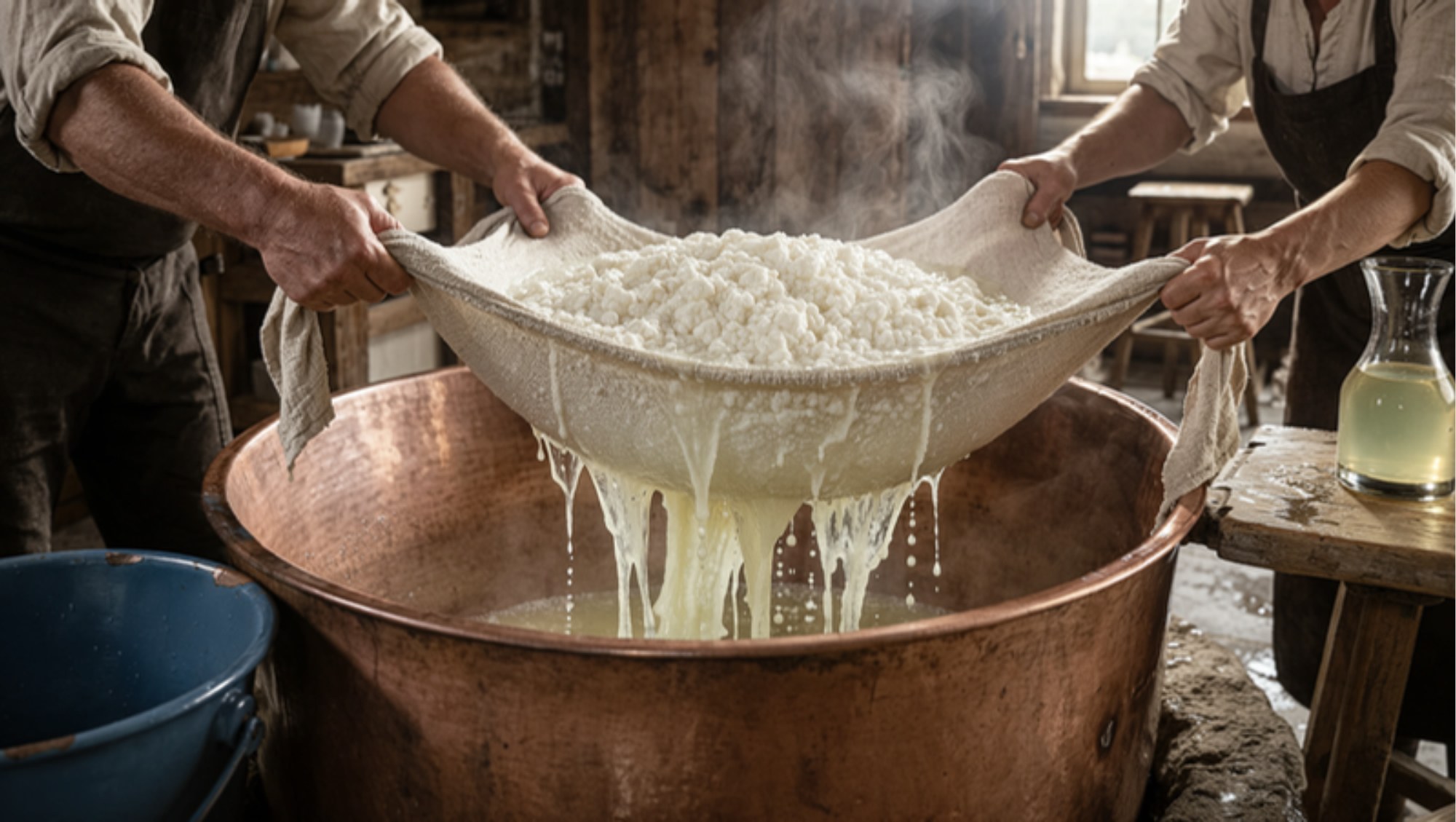
When milk is made into cheese, it separates into solid curds and a liquid.1 That liquid is whey.1 Whey makes up about one fifth of the protein in milk.2
How is whey protein made? Concentrate, isolate and lactose
The whey is filtered. The protein stays, while milk sugar (lactose) and minerals pass through.1 Then it is dried to a powder.1
Depending on how far it is filtered, you get three types:1
| Type | What it is | Lactose |
|---|---|---|
| Concentrate | Filtered whey, often about 80% protein3 | More than isolate3,4 |
| Isolate | Filtered further, at least 90% protein1 | Very little4 |
| Hydrolysate | Whey protein broken into smaller pieces by enzymes2 | Depends on the starting whey |
Why did whey become the default?
- It is a high-quality protein. It has every essential amino acid in good amounts, and the body uses it well, which is how protein quality is scored.5 In one worked example, whey protein isolate supplied each essential amino acid above the amount needed.6
- It has a high share of essential amino acids. In a lab comparison of protein powders, whey had the highest share.7
- It is rich in leucine, an essential amino acid.7
- It is absorbed quickly. In a study comparing milk proteins, the amino acids from whey were absorbed faster than those from casein, the other milk protein.8
Whey or plant protein?
Most plant proteins need a larger portion to match the leucine in whey.7
In two studies of young adults new to strength training, soy and whey gave similar muscle and strength gains when leucine or total protein was matched.9,10
Is whey the most "complete" protein?
"Complete protein" is a common term for a protein that has enough of every essential amino acid and that the body digests well.5
Whey fits that. So do milk and egg. Soy does too on an older scoring method.5
Plant proteins can also contain all the essential amino acids, but most are low in one or two of them:7
Of ten plant proteins tested in one lab study, only potato met the requirement for every essential amino acid.7 Mixing plant proteins can close the gap.7
Questions
What is the difference between whey isolate and concentrate?
Is whey a by-product of cheese?
Yes. It is the liquid that drains off when cheese is made.1
Is whey protein vegan?
No. It comes from cow's milk.2
What's in ovane
ovane original uses whey protein isolate and lactose-free milk powder. A serving contains about 0.2 g of lactose, which comes from other ingredients such as the whey. ovane contains milk.
Sources
- Reig M, Vecino X, Cortina JL (2021). Use of membrane technologies in the dairy industry: an overview. Foods. https://pubmed.ncbi.nlm.nih.gov/34829049/ — what whey is; how it is filtered and dried; isolate at least 90% protein.
- Gilmour SR et al. (2024). Amino acid composition of dried bovine dairy powders from a range of product streams. Foods (authors work for Fonterra, a dairy company, which funded the analysis). https://pubmed.ncbi.nlm.nih.gov/39682973/ — whey is about one fifth of milk protein; hydrolysate made with enzymes; comes from cow's milk.
- American Dairy Products Institute (ADPI). Whey Protein Concentrate. https://www.adpi.org/whey/whey-protein-concentrate/ — protein and lactose in concentrate.
- US Dairy Export Council. Whey protein isolate (whey categories). https://www.thinkusadairy.org/products/whey-protein-and-ingredients/whey-categories/wpi — isolate has very little lactose.
- Hertzler SR et al. (2020). Plant proteins: assessing their nutritional quality and effects on health and physical function. Nutrients. https://pmc.ncbi.nlm.nih.gov/articles/PMC7760812/ — protein quality; what "complete protein" means; whey, milk, egg and soy.
- Moughan PJ, Lim WXJ (2024). Digestible indispensable amino acid score (DIAAS): 10 years on. Frontiers in Nutrition. https://pubmed.ncbi.nlm.nih.gov/39021594/ — worked example: whey isolate supplies every essential amino acid above the amount needed.
- Gorissen SHM et al. (2018). Protein content and amino acid composition of commercially available plant-based protein isolates. Amino Acids. https://pubmed.ncbi.nlm.nih.gov/30167963/ — whey's share of essential amino acids and leucine; plant proteins low in lysine or methionine; potato; mixing plant proteins.
- Boirie Y et al. (1997). Slow and fast dietary proteins differently modulate postprandial protein accretion. PNAS. https://pubmed.ncbi.nlm.nih.gov/9405716/ — whey is digested faster than casein.
- Lynch HM et al. (2020). Soy and whey protein supplements matched for leucine. International Journal of Environmental Research and Public Health. https://pubmed.ncbi.nlm.nih.gov/32486007/ — similar gains with soy and whey when leucine was matched.
- Hevia-Larraín V et al. (2021). High-protein plant-based diet versus a protein-matched omnivorous diet. Sports Medicine. https://pubmed.ncbi.nlm.nih.gov/33599941/ — similar gains when total protein was matched.