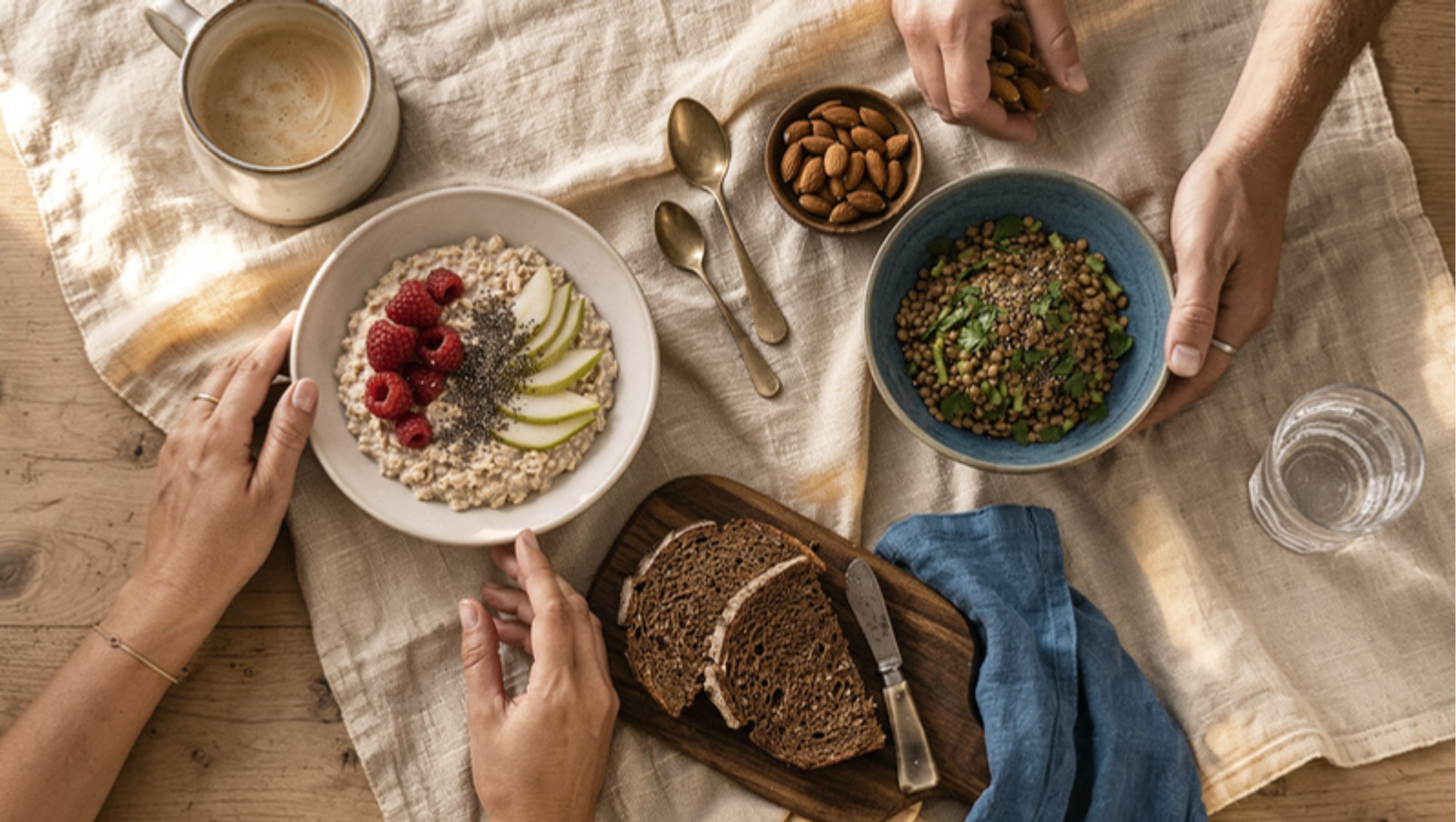
Fibre is called Ballaststoffe in German. This page only reports what studies and official bodies say. How much to eat is on a separate page: How much fibre do you need a day?
What is fibre?
Fibre is the part of food that the small intestine cannot digest.1 It travels on to the large intestine, where gut bacteria break down part of it. Fibre mainly occurs in plant foods; meat, fish, eggs and dairy contain almost none.
There are different types of fibre, for example soluble and insoluble. Researchers say this split is too simple, because fibres also differ in structure, water binding and how fast bacteria ferment them.
What does fibre do in the gut and for digestion?
Fibre adds bulk to stool. Cereal and vegetable fibre have been found to add more bulk than fruit fibre.3 EFSA considers 25 g a day adequate for normal bowel function.4
In studies of people with constipation, fibres such as psyllium and pectin have been shown to help, mostly at higher amounts and over several weeks.5
What happens to fibre in the large intestine?
Gut bacteria turn part of the fibre into short-chain fatty acids such as butyrate.6 Butyrate is the main fuel of the cells lining the colon.7
Is fibre a prebiotic? Inulin, FOS and acacia fibre
Some fibre is, but not all of it. A prebiotic is a substance that gut microbes use selectively and that benefits health.8
Most fibres feed many kinds of microbes, so they do not count as prebiotics. A few fibres do. Inulin, FOS (fructo-oligosaccharides) and acacia fibre are widely known as prebiotics, but in Europe there is no specific claim for this. Inulin and FOS are found, for example, in chicory.
You may read that prebiotics are simply "fibre that feeds good bacteria". That is a simplified version of the definition. In the EU there is no approved health claim for a prebiotic effect.
What is fibre linked to in large studies?
Large studies link a higher fibre intake with a lower risk of heart disease, type 2 diabetes and bowel cancer.9
The WHO bases its fibre guideline on these studies. It recommends at least 25 g of fibre a day from foods.12
These are links, not proof, because people who eat more fibre also differ in other habits.
Does fibre help with fullness or body weight?
The research does not give one clear answer.
Fullness. In meal studies in healthy adults, some soluble fibres led people to eat less at the next meal. Guar gum, beta-glucan and alginate had the largest effects.10 The review rated the risk of bias as high in every trial it included, and it measured how much people ate, not how full they felt. There is no official health claim that can be made that fibre helps with fullness, as this has not been judged as convincing enough.
Body weight. Official bodies disagree. The WHO guideline reports that higher fibre intake may lead to small reductions in measures of body fatness, based on reviews of trials and cohort studies.9 The UK SACN found no effect of fibre on body weight in trials.2 A review of trials in people with overweight, using isolated soluble fibre for at least 12 weeks, found a small average difference in body weight.10
In the EU, the only authorised weight claim for a fibre is for glucomannan, and only as part of an energy-restricted diet. There is no authorised claim that fibre makes you feel full.11
Which fibres have an EU health claim?
The EU allows health claims only for named fibres, never for fibre in general. Each claim comes with conditions, for example a minimum amount or a food that is high in fibre.11
| Fibre | Allowed EU claim - check for conditions of use, different ones apply |
|---|---|
| Wheat bran fibre | Contributes to an acceleration of intestinal transit |
| Wheat bran fibre | Contributes to an increase in faecal bulk |
| Oat grain fibre | Contributes to an increase in faecal bulk |
| Barley grain fibre | Contributes to an increase in faecal bulk |
| Sugar beet fibre | Contributes to an increase in faecal bulk |
| Rye fibre | Contributes to normal bowel function |
| Native chicory inulin | Contributes to normal bowel function by increasing stool frequency |
| Beta-glucans (from oats, oat bran, barley or barley bran) | Contribute to the maintenance of normal blood cholesterol levels |
| Beta-glucans from oats and barley | Consumption of beta-glucans from oats or barley as part of a meal contributes to the reduction of the blood glucose rise after that meal |
| Arabinoxylan from wheat endosperm | Consumption of arabinoxylan as part of a meal contributes to a reduction of the blood glucose rise after that meal |
| Pectins | Contribute to the maintenance of normal blood cholesterol levels |
| Pectins | Consumption of pectins with a meal contributes to the reduction of the blood glucose rise after that meal |
| HPMC (hydroxypropyl methylcellulose) | Hydroxypropyl methylcellulose contributes to the maintenance of normal blood cholesterol levels |
| HPMC (hydroxypropyl methylcellulose) | Consumption of Hydroxypropyl methylcellulose with a meal contributes to a reduction in the blood glucose rise after that meal |
| Glucomannan (konjac mannan) | Contributes to the maintenance of normal blood cholesterol levels |
| Glucomannan (konjac mannan) | Glucomannan in the context of an energy restricted diet contributes to weight loss |
| Guar gum | Contributes to the maintenance of normal blood cholesterol levels |
| Chitosan | Contributes to the maintenance of normal blood cholesterol levels |
| Resistant starch | Replacing digestible starches with resistant starch in a meal contributes to a reduction in the blood glucose rise after that meal |
Questions
Is soluble or insoluble fibre better?
Neither. Both have their benefits, variety always wins.
Is fibre the same as a prebiotic?
No. Most prebiotics are fibres, but only some fibres are prebiotics: those that gut microbes use selectively and that benefit health. E.g. inulin, acacia fibre and FOS are widely known as prebiotics, but this term cannot be used by companies in the EU.
Does fibre help with weight loss?
Studies disagree. Some show a small effect, some none. Fibre is not a weight loss method.
Does fibre keep you full?
Some fibres led people to eat less at the next meal in meal studies, others did not. The evidence is weak.
Does fibre feed gut bacteria?
Partly. Bacteria break down part of it into short-chain fatty acids. Some parts just pass through your intestines.
Sources
- Regulation (EU) 1169/2011, Annex I point 12 (definition of fibre): https://eur-lex.europa.eu/LexUriServ/LexUriServ.do?uri=OJ:L:2011:304:0018:0063:en:PDF
- UK SACN, Carbohydrates and Health, 2015, para 8.162 (body weight): https://assets.publishing.service.gov.uk/media/5a7f7cc3ed915d74e622ac2a/SACN_Carbohydrates_and_Health.pdf
- de Vries et al., Nutrients 2016 (funded by a cereal manufacturer): https://pubmed.ncbi.nlm.nih.gov/26950143/
- EFSA Journal 2010;8(3):1462: https://doi.org/10.2903/j.efsa.2010.1462
- van der Schoot et al. 2022: https://pubmed.ncbi.nlm.nih.gov/35816465/
- Parada Venegas et al., Front Immunol 2019: https://pubmed.ncbi.nlm.nih.gov/30915065/
- Morrison & Preston, Gut Microbes 2016: https://pubmed.ncbi.nlm.nih.gov/26963409/
- Gibson et al. 2017, ISAPP consensus statement on prebiotics: https://pubmed.ncbi.nlm.nih.gov/28611480/
- Reynolds et al., Lancet 2019 (basis of the WHO 2023 guideline): https://pubmed.ncbi.nlm.nih.gov/30638909/ ; WHO guideline: https://www.who.int/publications/i/item/9789240073593
- Salleh et al., Foods 2019 (soluble fibre, energy intake and fullness): https://pubmed.ncbi.nlm.nih.gov/30621363/ ; Huwiler et al., Nutrients 2022 (soluble fibre supplements, body weight): https://pubmed.ncbi.nlm.nih.gov/35807808/
- Reg (EU) 432/2012, consolidated 20.08.2025: https://eur-lex.europa.eu/legal-content/EN/TXT/HTML/?uri=CELEX%3A02012R0432-20250820 ; Reg 40/2014 (sugar beet fibre): https://eur-lex.europa.eu/eli/reg/2014/40/oj ; Reg 2015/2314 (chicory inulin): https://eur-lex.europa.eu/eli/reg/2015/2314/oj
- WHO news item, 17 July 2023: https://www.who.int/news/item/17-07-2023-who-updates-guidelines-on-fats-and-carbohydrates